
Follow on Spotify | Subscribe on Apple Podcasts | Amazon | Pocket Casts | iHeartRadio | other platforms
The outfit you’re wearing right now took more water to make than you’ll drink before you turn 40. (The cotton, the nylon, the phone in your pocket, this morning’s coffee: all of it runs on water.)
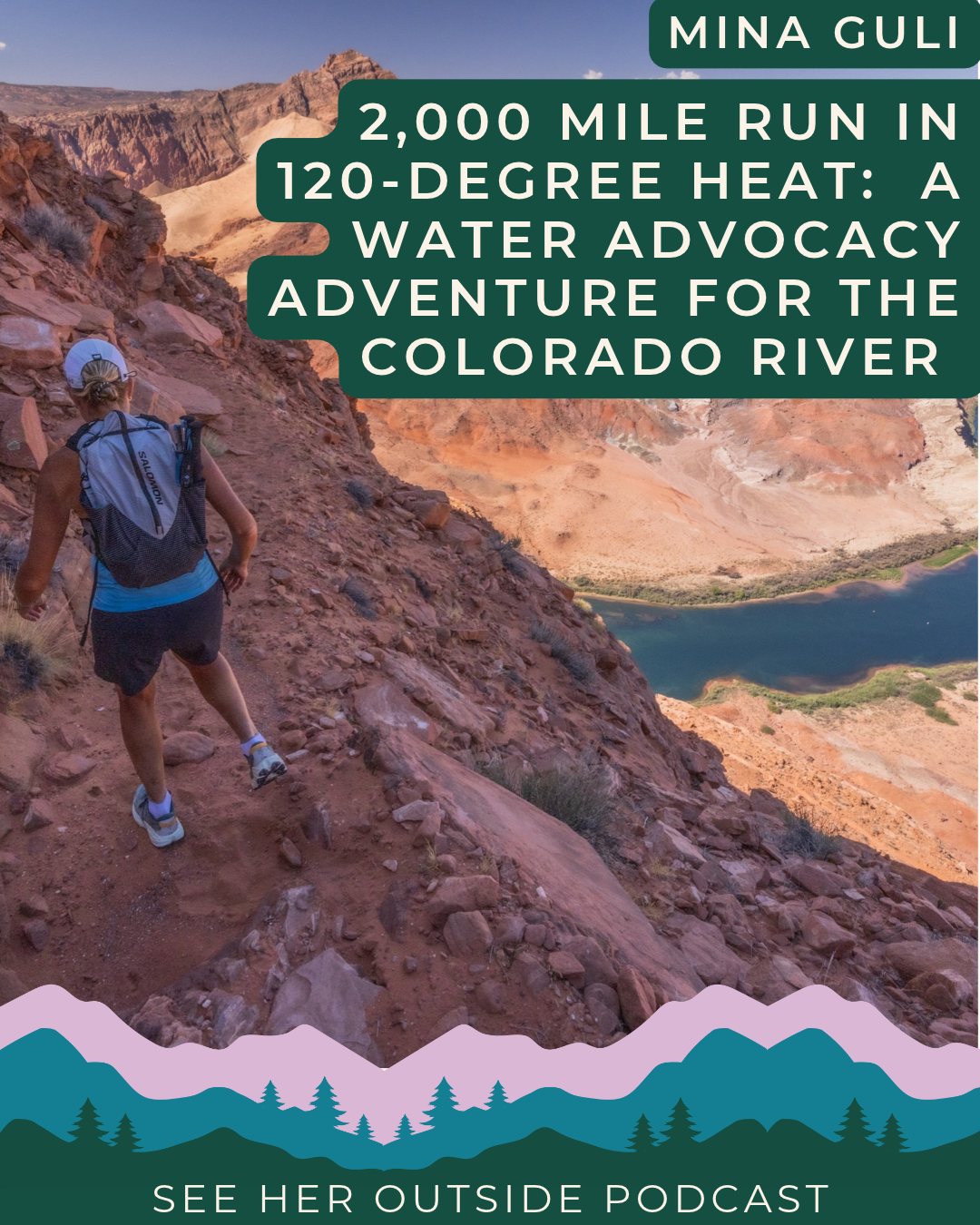
Mina Guli has spent a decade running to make that water visible. This summer, that meant 2,000 miles along the Colorado River, alarms at 1:30 a.m. to beat 120-degree heat, and $32 million in new commitments to the river basin by the end.
She also calls herself “the biggest chicken on the planet,” and before this run she had never backpacked overnight. She learned the skills, built the systems, and brought the right people with her.
(If that makes you want a big, scary goal of your own, the Trail Running Sisterhood opens applications November 2: 36 women running their first trail ultra or trail half marathon at Wild Woman Trail Runs in June 2027. Get on the interest list here.)
Mina Guli is a water advocate and ultrarunner. After a 15-year career in law, finance, and climate change, she founded Thirst Foundation, a nonprofit focused on changing how we think about water. She has since logged more than 25,000 miles during global advocacy campaigns, including Keep the River Running, her longest single-river run to date. She has been named a Young Global Leader by the World Economic Forum and one of Fortune’s 50 greatest leaders in the world.
Mina started all this in 2016 with no running background (by her own account, she didn’t even like running). Through the Grand Canyon, she ran with Sunny Stroeer, an endurance athlete who knows the canyon like the back of her hand. Full disclosure: Sunny is also the executive director of the GEA Alliance, which presents this podcast.
Mina and Angie talked about:
- Why the clothes you’re wearing took more water to make than you’ll drink before age 40
- “If climate is a shark, water is the teeth”
- Why the Colorado River: 40 million people, $1.2 trillion in economic activity, and 90% of winter leafy greens
- Building a pie factory instead of dividing up the crumbs: fragmentation, financing, and future-proofing
- Planning a 2,000-mile summer run around wildfires, drought, and 150-degree sun
- Choosing 25 kilos of water over pack rafts at the top of the Nankoweap Trail
- Crying on a flat rock halfway down, and what Mina realized there
- The viral Deer Creek video and what the comment section missed about two women in their 50s
- Why adventure media rewards the scariest-looking clip over the useful how-to
- Running 200 marathons in 32 countries, hearing crickets, and redesigning the campaign around outcomes
- How Keep the River Running secured $32 million from the Coca-Cola Foundation, Amazon, and Grundfos
- What you can do about water without lacing up
Check out these resources:
- 🌐 Mina Guli’s website
- 💧 Keep the River Running
- 📱 Mina on Instagram
- ✨ Mina on LinkedIn
- 🏃♀️ Trail Running Sisterhood interest list (applications open November 2)
- ➡️ The Cairn Project on IG
- ✨ The Cairn Project’s newsletter
- 🥾 Become a Trailblazer
- 📅 Summit Scholarship Foundation
Like this episode? Leave a 5-star rating and review on your podcast app!
You can help us close the gender gap outdoors and beyond:
- Become a Trailblazer. Your Adventure Fundraiser makes wilderness experiences possible for girls and women.
- Check out the Summit Scholarship Foundation.
- Send this episode to a friend who keeps saying “I could never do that.”
Make sure you subscribe to the See Her Outside Podcast so you don’t miss a story!
Follow on Spotify | Subscribe on Apple Podcasts | Amazon | Pocket Casts | iHeartRadio | other platforms
Mina Guli is a water advocate and ultrarunner who founded Thirst Foundation after 15 years in law, finance, and climate change. On the See Her Outside Podcast, she explains why water is the foundation of everything we buy and use, from cotton and nylon to computer chips, mining, and food, and why our water use is growing at twice the rate of our population. She describes a forecast 40% shortfall of usable water supply against demand, and what that looks like on the ground: kids kept home from school to wait for water deliveries, farmers deciding whether to pray for rain or leave their farms, and whole communities forced to move.
The Colorado River supports 40 million people, 16 million jobs, and $1.2 trillion in economic activity, and it grows 90% of the leafy greens available in winter. Mina describes standing under the bathtub rings at Lake Mead and Lake Powell during a multi-year drought, the risk of the reservoirs reaching deadpool, and why the Colorado River renegotiation should focus on abundance rather than scarcity. Her answer is three problems to fix at speed and scale: fragmentation, financing, and future-proofing.
Keep the River Running took Mina 2,000 miles on foot over about three months, from Boulder to where the Colorado runs out in Mexico, then on to Los Angeles. She talks through expedition planning for extreme heat: running from 2 a.m. to 10 a.m., hiking umbrellas, water-soaked shirts, two Garmins for redundancy, and wildfire detours around the Babylon and Snyder fires after the Dragon Bravo fire delayed the run a full year. In the Grand Canyon, she and Sunny Stroeer chose to carry 25 kilos of water instead of pack rafts down the Nankoweap Trail, and every tributary on the way down was dry.
Mina also talks about adventure as advocacy and the online criticism two women in their 50s faced in the Grand Canyon. After running 200 marathons in 32 countries ahead of a UN water conference brought media but little change, she rebuilt her approach around outcomes: four summits across the basin, a financing summit during Climate Week in New York, and $32 million from the Coca-Cola Foundation, Amazon, and Grundfos toward a $100 million commitment to the Colorado River Basin. She closes with everyday ways to protect water: cut food and textile waste, ask your employer about water risk in its supply chain, and put water on your elected officials’ agenda.
